
Pressure, Temp & Environmental · 4 min read
Pressure Gauge & Transducer Calibration
Pressure instruments span analog gauges to high-accuracy transducers, and the calibration approach scales with the accuracy you need — but the fundamentals are the same across all of them.
Part of our guide to Pressure, Temperature & Environmental Calibration.
How it is done
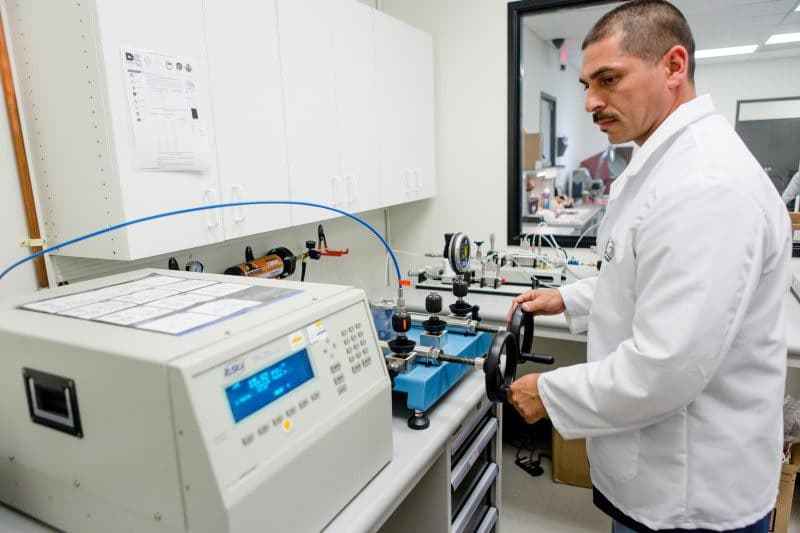
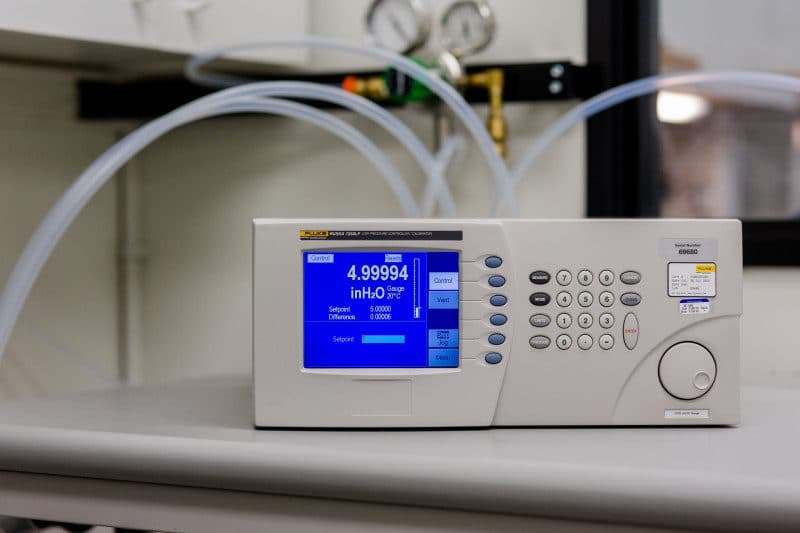
The instrument is subjected to known pressures generated and measured with a traceable reference — a deadweight (pressure balance) tester for the highest accuracy, or a precision pressure controller/comparator — across multiple points up and down its range. Testing both increasing and decreasing pressure reveals hysteresis, which a single-direction check would hide.
What the certificate shows
Expect as-found/as-left readings at each point, measurement uncertainty, and the reference used, with pass/fail against your tolerance. For transducers feeding a control system, the electrical output (mA or V) is verified alongside the pressure so the whole signal path is trustworthy.
Common questions
What is a deadweight tester?
A pressure balance that generates a highly accurate, traceable pressure using calibrated masses on a piston of known area. It is among the most accurate ways to realize pressure for calibration.